
Metrics & Reports
PullPro measures how your team's pull requests move from ready for review to merged. A recurring report lands in Slack, and a metrics page shows the same figures over a longer span with the pull requests behind each one.
Recurring Report
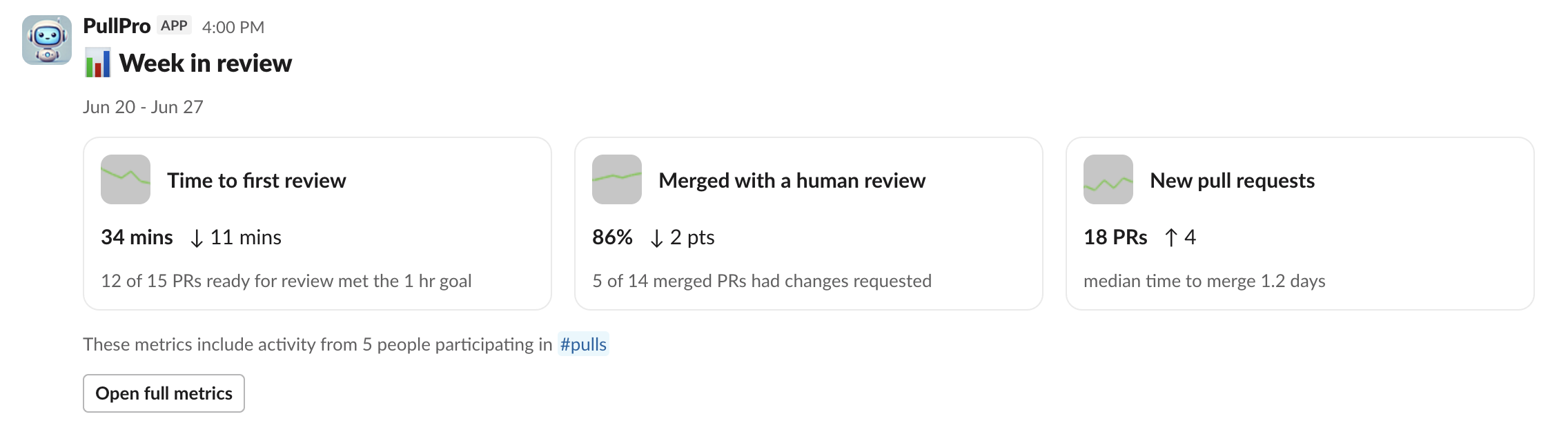
PullPro posts a recurring report to each channel on the cycle you choose. It covers the period since the last report and leads with three figures, each carrying its trend against the previous period and a sparkline of recent periods:
- Time to first review — the median wait from a pull request becoming ready for review to its first human review.
- Merged with a human review — the share of the period's merged pull requests that someone other than the author reviewed.
- New pull requests — how many arrived in the channel.
Under each figure is a supporting line for the same period, and, where the channel is set to show individual figures, a short list of the people behind it. Where a channel has a time-to-review goal, the report also says how many pull requests met it, out of every pull request whose goal window has closed — so one nobody reviewed counts against the goal rather than disappearing from it.
The report ends with a link to the metrics page and a note of who was included.
Customizing Reports
In the Slack home tab for PullPro, open the channel settings to:
- Configure how often and when reports are sent.
- Change your goals and thresholds for key metrics.
- Choose the granularity: Individual adds the per-person rows to the report and the metrics page, Team keeps both to the channel's own figures.
The Metrics Page
Open full metrics at the bottom of the report opens a page covering the same channel over a longer span. It holds six metrics — the three from the report plus Changes requested, PRs reviewed and Time to merge.
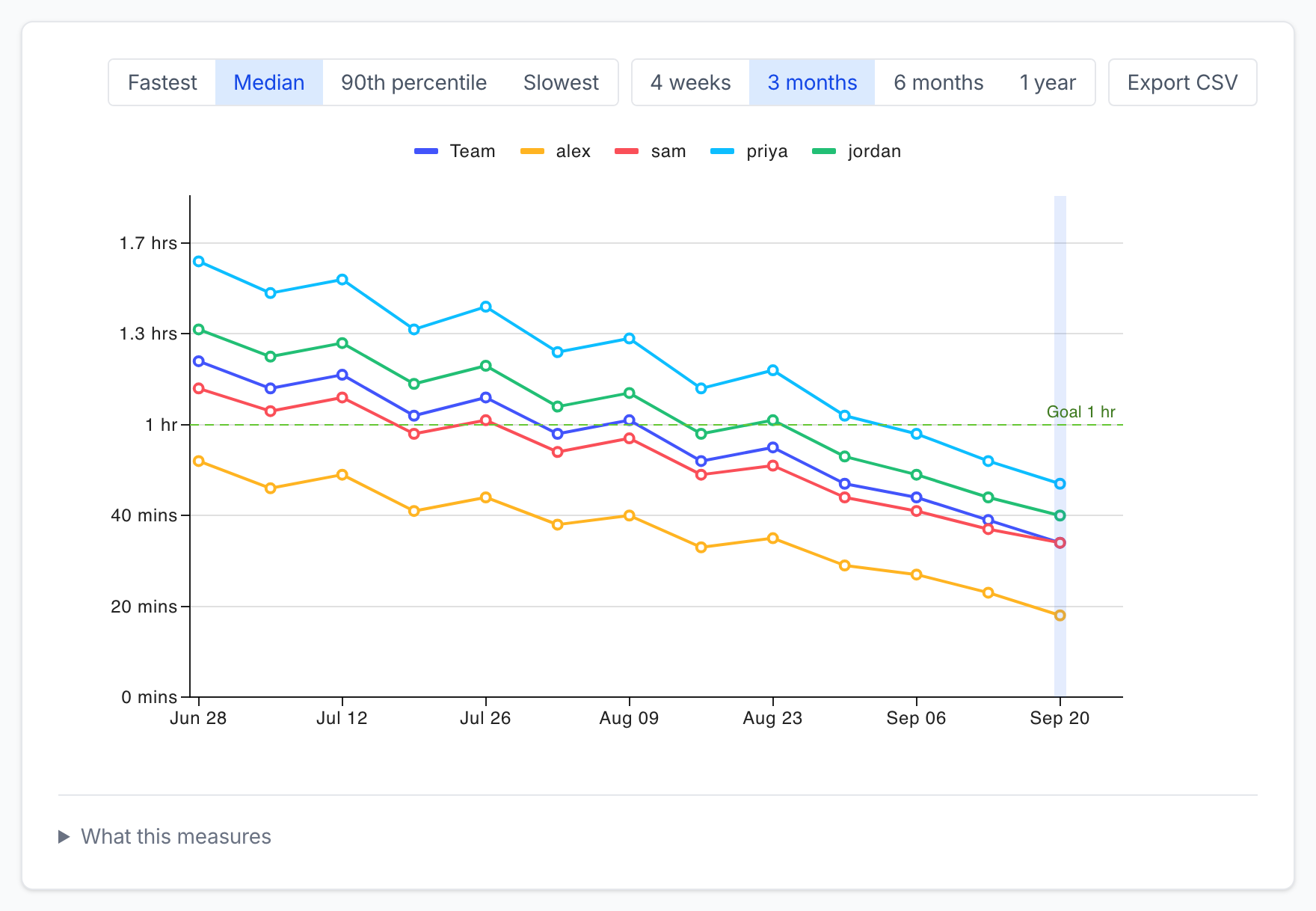
- Pick a span. The chart plots one point per report period, and the range buttons change how far back it goes. Up to 12 months of history is kept.
- By person. Where the channel is set to show individual figures, each metric has a table beneath the chart: the team's own figure, then a row per person with their best, typical and worst period and how many periods they had data for. Tick a row to plot it on the chart; untick the team row to show only the people you ticked. Any column sorts, and the table exports to CSV.
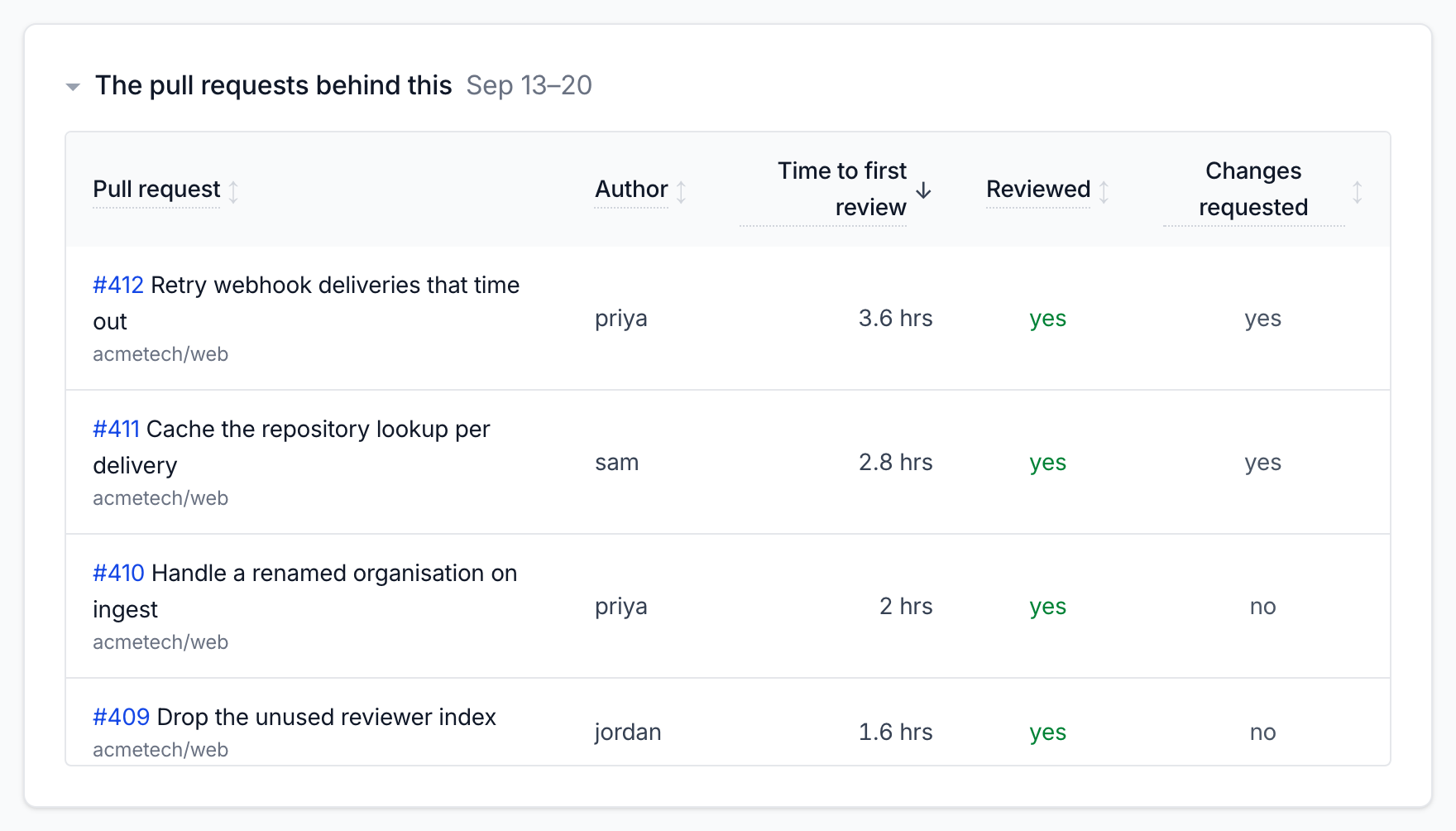
- See the pull requests behind a figure. Click any point on the chart to list the individual pull requests that made up that period, worst first, each with the figure it contributed. If you have narrowed the table to particular people, the list follows that.
- Check a definition. Each metric has a What this measures panel stating exactly what it counts.
What the Metrics Mean
A human review is a review left by someone other than the pull request's author. Reviews from bots do not count towards any metric.
The author is whoever opened the pull request, or the first person assigned to it when a bot opened it — see bot-authored PRs.
- Time to first review — from ready for review to the first human review. Counts working hours only. Split by reviewer.
- Merged with a human review — of the pull requests merged in the period, the share with a human review. A review from before the period still counts. Split by author.
- Changes requested — of the pull requests merged in the period, the share where a human requested changes at least once. Split by author.
- PRs reviewed — distinct pull requests reviewed. Two reviews on one pull request count once. Split by reviewer.
- New pull requests — pull requests that reached the channel in the period. For a draft, when it was marked ready for review. Split by author.
- Time to merge — from ready for review to merging. Elapsed time, not working hours. Split by author.
Two things worth knowing about the numbers:
- Working hours apply to time to first review, not to time to merge. A review that arrives on Monday morning after a Friday afternoon pull request is a short wait; the merge that follows is measured in elapsed days. See working hours to set your team's.
- Only pull requests shared to Slack by PullPro are measured.
Stats Slash Command
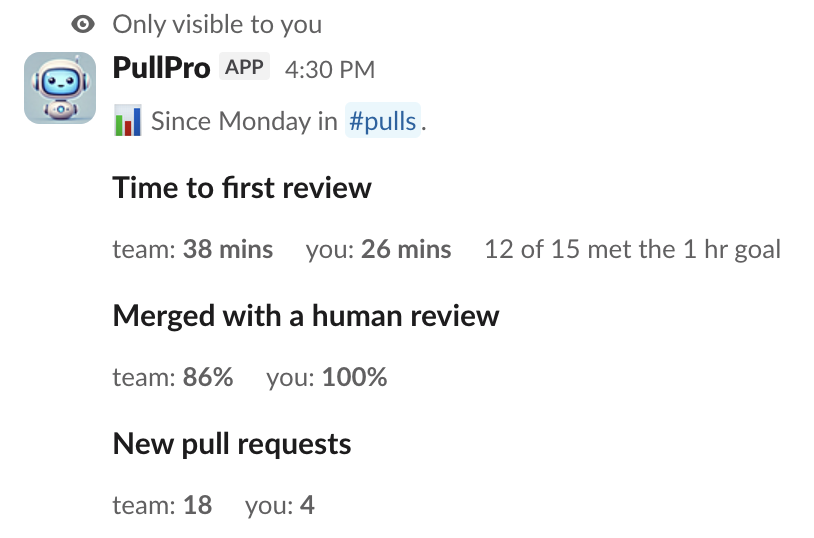
For an on-demand summary, use the /pr stats slash command in a channel. It answers with the same three
metrics the recurring report leads with, covering the week so far, and puts your own figure beside the
channel's.